


One of the hardest and most emotionally draining experiences a couple can face is working through an affair. This requires patience, deep honesty, and a willingness from both partners. Healing doesn’t happen right away, but it comes through constant effort, emotional courage, and a shared commitment to try to rebuild something new.
For many couples, this process can bring up layers of grief, not just about the betrayal but about the loss of what the relationship once was. This is emotionally hard, and it can make recovery challenging but also deeply changing.
Healing After an Affair Can Be Challenging
There are many couples that actually do survive after infidelity, but it requires intentional and hard work. This involves rebuilding trust, redefining the relationship, and restoring emotional safety. Instead of going back to what it was, the couples have to create a new version of their relationship that is emotionally connected, conscious, and aligned with what they need currently.
According to different therapeutic models, there are three phases that have to happen for recovery:
- Repairing the damage.
- Reconnecting emotionally.
- Rebuilding long-term trust.
Each of these phases requires the couples to use different skills and to be vulnerable. It’s normal for partners to move through these phases at their own pace, where some might spend more time rebuilding their emotional safety, and others might focus more on communication. What matters in this situation isn’t speed but consistency.
Choosing Couples Therapy
One thing about rebuilding trust is that it can’t happen in isolation. Therapy can support personal growth, but it doesn’t always repair the shared emotional bond that is needed between the partners. Healing needs both individuals to actively participate in rebuilding the connection that they once shared.
When both partners are open to the healing and reconciliation, they can work together in a structured environment, and this allows them to have:
- Honest conversations.
- Transparency over secrecy.
- Emotional reconnection to start.
One partner has to be open to talking about what happened, even when it feels uncomfortable or emotionally draining. The other has to have space to process the emotions and to feel secure again. As time goes on, having shared conversations can help to rebuild a sense of partnership instead of separation.
The goal in this is to re-establish emotional intimacy where both partners feel heard, seen, and valued again.
Truth Comes Gradually
In a lot of situations, the full story of the fear doesn’t come out at once. The partner who was unfaithful might hold back the details because of fear, confusion, guilt, or the desire to protect their partner and themselves from more pain.
When this happens, it can be extremely frustrating for the partner who was betrayed and wants complete clarity right away so they can regain a sense of stability and control.
Healing requires patience. The information often comes out in layers, and if you push too hard or too fast, it can cause emotional shutdown or defensiveness. Withholding too much information can feel like more betrayal and can damage trust even further.
The Affair Was a Choice, But the Relationship Still Matters
An affair doesn’t happen because of the relationship alone, but it’s still a personal decision. But that doesn’t mean the relationship doesn’t need attention afterward.
What comes up after something like this usually shows where things were missing, ignored, or needed more care. Instead of trying to go back to how things were, couples often have to focus on doing things differently moving forward.
That can look like:
- Creating better communication habits.
- Talking about emotional needs that weren’t being met.
- Putting in effort to support each other more consistently.
- Learning how to handle conflict in a healthier way.
This isn’t about placing blame. It’s about understanding what was happening underneath everything.
A lot of couples say this stage feels less like “fixing the past” and more like starting over in a new way. The focus shifts from what went wrong to what can be done better.
If you want to read more about relationship dynamics and emotional connection, read about it at APA.
Creating the Right Structure After an Affair
Talking about an affair can get overwhelming fast if there aren’t some boundaries around it. Without structure, conversations can turn into:
- Arguments.
- Blame.
- Emotional shutdown.
And that makes healing harder instead of easier. Some things that help keep conversations more grounded:
- Setting specific times to talk about it.
- Agreeing to take a break if things start escalating.
- Avoiding patterns like criticism, defensiveness, or shutting down.
- Focusing on understanding instead of trying to “win.”
Having these boundaries creates a sense of safety and control for both people. It also helps prevent the situation from taking over every moment, so the relationship still has space for a normal connection, too.
Research also shows that betrayal can feel similar to trauma, with things like anxiety, intrusive thoughts, and emotional ups and downs. If you want more on that, click here.
Finding Balance with Your Questions
It’s completely normal to want answers after something like this. Asking questions can:
- Help you understand what happened.
- Reduce confusion.
- Give you a sense of control again.
But there’s also a point where too much detail can make things harder instead of helping. Going too deep, especially into painful or graphic details, can:
- Keep you stuck in the situation.
- Create mental replay loops.
- Make it harder to move forward.
The goal isn’t to know everything, but it’s to know enough. That usually happens over time, not all at once. Healing often reaches a point where you can honestly say: “I understand what happened, and I don’t need to keep going back to it.”
An affair changes things, but it also creates a moment where everything gets looked at more closely.
When both people are willing to be honest, take responsibility, and put in real effort, it becomes possible to create something different than what existed before. Not perfect but more aware, more intentional, and more real.
Rebuilding Trust Together

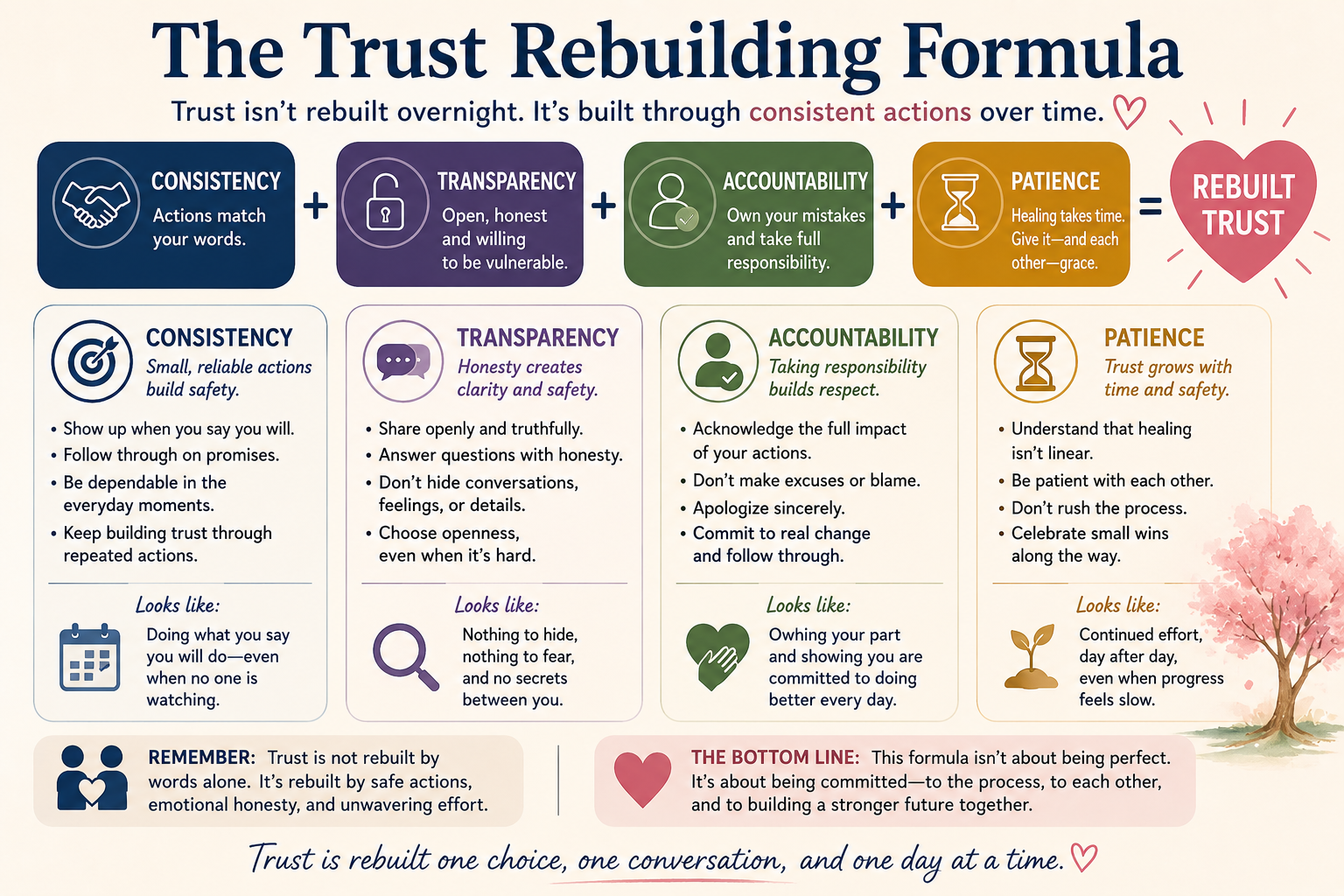
Trust can’t be rebuilt by just one partner. Even though the partner that broke the trust has to take responsibility by being honest and accountable, the other partner also has to recognize the process and allow trust to start growing again.
Instead of always being suspicious, for example, the betrayed partner has to start to notice moments where trust is returning, such as:
- Deciding not to check or verify what the partner said.
- Feeling less anxious about the separation.
- Acknowledging when there are positive behavioral changes.
Of course, the partner who had the affair has to be patient and understanding, knowing that rebuilding the trust will take time and repeated reassurance.
Trust comes through reliable actions that are repeated over time, not through just making promises. By keeping your behaviors consistent, this can be more than a big gesture.
Healing Isn’t Linear
Healing doesn’t follow a straight path. Some days will feel stable and hopeful, while others might bring back intense emotions that feel just as strong as they did in the beginning.
Even things like memories, places, or stress can bring up triggers and cause old feelings to come back to the surface. This is part of the healing process and not a sign of failure. As time goes on, couples who commit to the healing process will experience things like:
- Better communication skills.
- More intentional partnerships.
- More physical connections.
- Deeper emotional intimacy.
When children or family dynamics are involved, the healing goes beyond the couple. By addressing these areas in a thoughtful way, it can help restore a sense of stability in the entire family.
Final Thoughts: After an Affair, a Stronger Relationship is Possible
Yes, an affair is a deeply painful thing, but it can become a turning point for growth if both partners are willing to put in the work. It causes difficult conversations to happen that might otherwise have been avoided, and it opens up more self-awareness.
The goal in this is never to justify what happened but to change the relationship into something resilient, more honest, and connected.
When couples put in the effort, they can find that the new relationship feels even more meaningful than the one they had before. This doesn’t happen because of the betrayal, but because of the healing, intentionality, and communication that follow.
Frequently Asked Questions
1. Can a relationship heal after an affair?
Yes, some relationships can heal after an affair when both partners are willing to be honest, accountable, patient, and emotionally committed to repair.
2. How long does it take to heal from an affair?
Healing time varies. Some couples need months, while others need years to rebuild trust, emotional safety, and connection.
3. What is the first step after discovering an affair?
The first step is usually emotional stabilization. Both partners need space to process the shock before making major decisions.
4. Can trust be rebuilt after betrayal?
Trust can be rebuilt, but it requires consistent honesty, transparency, changed behavior, and patience over time.
5. What does accountability look like after an affair?
Accountability means taking responsibility without excuses, answering difficult questions honestly, and showing real change through actions.
6. Should couples talk about the details of the affair?
Some details may be necessary for healing, but conversations should be handled carefully so they create clarity rather than more emotional harm.
7. Is therapy helpful after an affair?
Therapy can help couples communicate safely, understand what happened, manage triggers, and decide whether to rebuild the relationship.
8. Why does betrayal hurt so much?
Betrayal can damage emotional safety, trust, identity, and the sense of security someone felt in the relationship.
9. What are common emotional reactions after an affair?
Common reactions include shock, anger, sadness, anxiety, confusion, grief, numbness, and fear about the future.
10. Can the relationship become stronger after healing?
Some couples become stronger after deep healing work because they learn better communication, clearer boundaries, and deeper emotional honesty.
11. What helps rebuild emotional safety?
Emotional safety grows through honesty, patience, empathy, reassurance, consistent behavior, and respectful communication.
12. What should the unfaithful partner do to help healing?
The unfaithful partner should take responsibility, stop secrecy, answer questions honestly, show empathy, and prove change through consistent actions.
13. What should the betrayed partner focus on?
The betrayed partner should focus on emotional healing, boundaries, support, self-care, and deciding what they need to feel safe again.
14. Is forgiveness required to heal?
Forgiveness is personal and should not be rushed. Healing can begin with truth, boundaries, and emotional clarity.
15. What are triggers after an affair?
Triggers are reminders that bring back painful emotions, such as phone secrecy, certain places, dates, messages, or changes in behavior.
16. How should couples handle triggers?
Couples can handle triggers by staying calm, offering reassurance, listening without defensiveness, and discussing what support is needed.
17. What boundaries are needed after an affair?
Helpful boundaries may include transparency around communication, ending contact with the affair partner, honest check-ins, and clear expectations.
18. When should a couple consider separating?
Separation may be worth considering if there is continued dishonesty, emotional harm, repeated betrayal, or no willingness to repair.
19. Can love still exist after an affair?
Love may still exist, but love alone is not enough. Healing also requires trust, accountability, safety, and changed behavior.
20. What is the main lesson of affair recovery?
The main lesson is that healing takes more than apologies. It requires honesty, responsibility, patience, and consistent effort over time.