


Choose a psychic specialty by asking what the session actually involves. Tarot and astrology describe methods; relationship and career describe subjects; email, phone and chat describe formats. A profile may combine all three.
Start with one reflective question, then compare the method, explanation style, price and limits. An impressive label is less useful than a clear description of what you are buying.
Match your question with a clearly described method
| Interest | Possible method | Ask before booking |
|---|---|---|
| Visual reflection | Tarot or oracle | Will you explain the cards and spread? |
| Symbolic chart patterns | Astrology | What birth data and chart technique do you need? |
| Number-based themes | Numerology | Which calculation and timing rules do you use? |
| A loved one’s memory | Mediumship | What can you promise, and what remains uncertain? |
| Dream imagery | Dream interpretation | How do you include my personal associations? |
| A factual or urgent concern | Relevant factual source or qualified professional | Who can actually establish the information I need? |
Scroll sideways to see the full table.
Start with the Outcome You Can Ask For
Write down what you want to get out of the reading in one sentence. You might want to reflect on a recurring dream, look at feelings about a job transition, or listen to how the reader interprets a symbolic system. These are good starting points instead of wanting someone to tell you your whole future.
Then take what you ask and identify what could count as a useful reading. Maybe you want a thoughtful explanation of the symbols, a question to help you organize your priorities, or a spiritual perspective that you consider afterwards. Keep the goal separate from a guarantee that an event will happen in the future.
If you have a real need and it’s a verified fact, ask if the reader is able to give it. An employer can tell you about a job offer, a partner can tell you what they hope for, and a qualified professional can address a question in their area of expertise.
A psychic reading might be an optional part for reflection, but it shouldn’t become the only way to get information that can be given more directly.
Ability Vs. Subject
Clairvoyance is described by practitioners as intuitive seeing. Clairaudience refers to claimed intuitive hearing, clairsentience to claimed intuitive feeling, and claircognizance to a claimed sense of knowing. These are terms that describe how the reader characterizes their experience, and they do not establish the accuracy of those experiences.
A love and career psychic reader talks about subjects. Tarot card readers and astrologers describe systems and methods. Phone, email, and live chat are different formats, and a single service can combine all these categories in one.
Someone might offer a live chat about relationships using tarot and impressions, for example, that they call clairvoyant. You might still need to ask what the reading includes and how interpretations are explained. Also ask what limits the reader puts on claims about people who aren’t there.
Don’t pay more just because a profile has more labels. A short, specific description can give you a clear way to choose instead of a long list of practical meanings that are unexplained.
Choose a Reading Specialty: visual guide
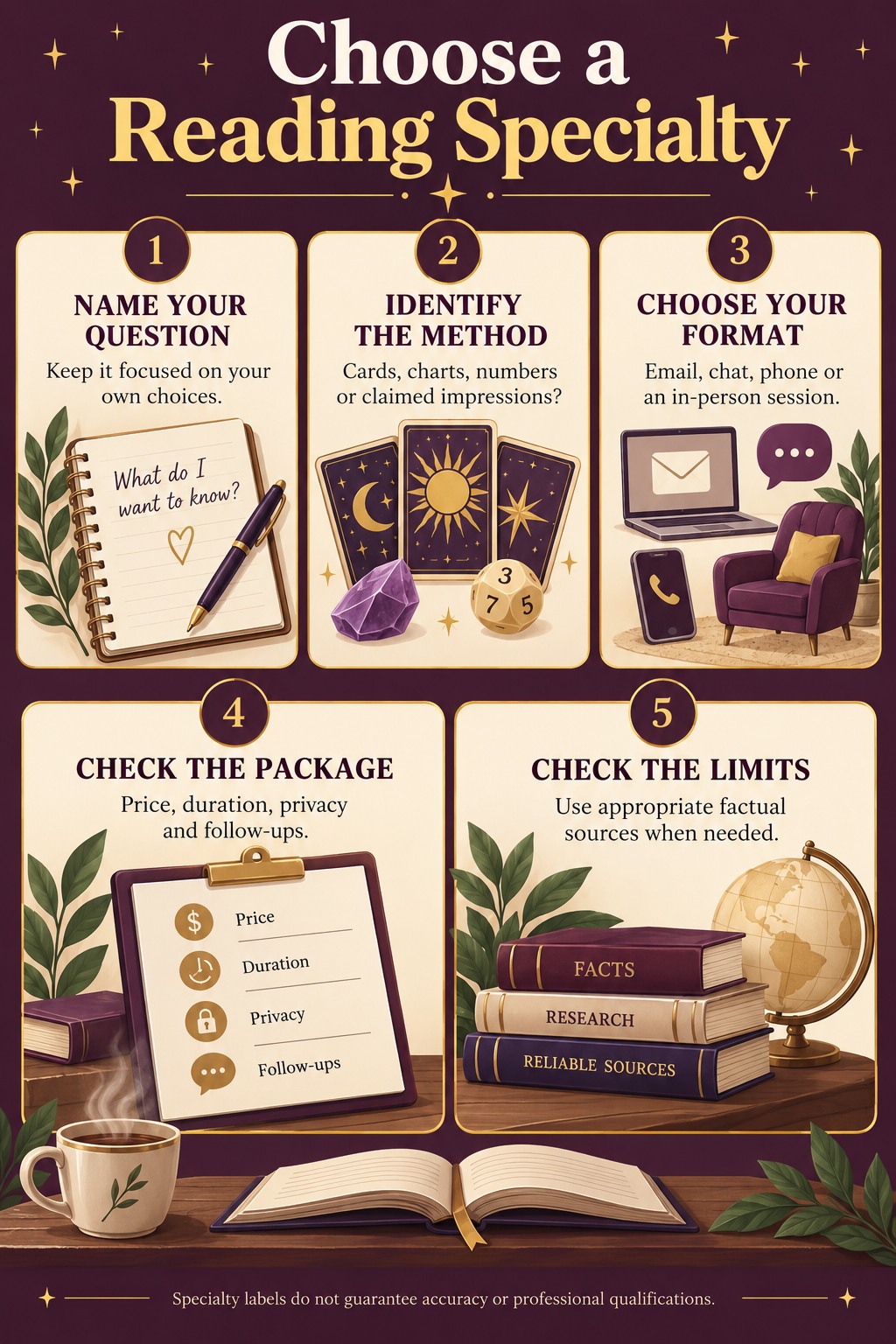
Read the infographic as text
- 1. NAME YOUR QUESTION: Keep it focused on your own choices.
- 2. IDENTIFY THE METHOD: Cards, charts, numbers or claimed impressions?
- 3. CHOOSE YOUR FORMAT: Email, chat, phone or an in-person session.
- 4. CHECK THE PACKAGE: Price, duration, privacy and follow-ups.
- 5. CHECK THE LIMITS: Use appropriate factual sources when needed.
When Tarot or Oracle Readings May Be a Good Fit
Tarot or oracle readings might be a good fit if you enjoy working with visual symbols and using them to look at a situation from a different perspective. A card spread can help you explore what is happening, what you might not have considered, and what your next step could be. Different decks and readers have their own styles, so one card reading can feel very different from another.
It can help to ask if the reader explains the cards as they go or mainly gives you their overall interpretation. Some people enjoy seeing the cards and learning why the reader connects certain meanings with them, while others would rather focus on the message of the reading. Knowing how the reader works can help you pick the style that feels right for you.
For example, if you are thinking about making a change at work, you might ask, “What should I consider before deciding between these options?” The cards could help you think about your priorities or look at the situation differently. You would still want to consider practical things like your salary, workload, qualifications, benefits, and the actual terms of the job before making your decision.
Be careful if someone uses tarot or oracle cards to tell you that you definitely have an illness, are pregnant, have been betrayed, or that a particular person committed a crime. Cards can be used for spiritual guidance and reflection, but serious claims like this need more than a card reading to know what is actually happening.
When Astrology May Be a Good Fit
Astrology might be a good fit if you enjoy looking at patterns, personality traits, relationships, and different themes through a birth chart. A natal chart usually uses your birth date, time, and location, while relationship astrology can compare two people’s charts or look at how their placements work together. It can help to ask what type of astrology the reader uses because there are different systems and ways of interpreting a chart.
Your birth time can make a difference in parts of your chart, especially your houses and rising sign. If you do not know your exact birth time, tell the astrologer instead of guessing. You might still be able to explore other parts of your chart without pretending that an uncertain birth time is exact.
Astrology can give you an interesting way to think about your personality, relationships, strengths, challenges, and patterns you notice in your life. It can also give you questions to think about, but having a detailed birth chart does not mean that every interpretation or prediction will automatically happen exactly as described.
If you are interested in a relationship astrology reading, remember that the other person’s birth information is still personal. A chart might give you something interesting to think about, but it cannot replace actually talking with someone about things like commitment, boundaries, trust, or what each of you wants from the relationship.
What Numerology Can Do
Numerology uses numbers from dates, common names, and other inputs according to tradition. It can work for someone who likes calculations followed by symbolic reflection. The methods are different, especially around master numbers and the timing of personal year cycles.
Ask the reader to show the calculations and explain how they came up with them. Correct math shows that the method was followed, but it doesn’t validate what is going to happen in your future.
A personal year reading can have you consider a theme such as cooperation or organization. You can look at the message and take action, such as clarifying what a shared responsibility looks like or looking at a routine that no longer fits you.
Don’t make financial, medical, or legal decisions based on a number. A reading can be interesting without becoming a substitute for information needed to make a choice responsibly.
Mediumship Is Claimed Communication
Mediumship often involves a reader’s claimed communication with deceased spirits. People might go for a mediumship reading because they are curious, grieving, or hoping for a sense of connection. The emotional importance of the subjects makes clear expectations important.
Ask the reader what they can and cannot promise you. No ethical description should require you to expect that a deceased person, an exact message, or guaranteed relief comes to you. You have to be free to decide what the interpretation means and whether it fits.
Think about how timing feels. A reading should not feel overwhelming, but getting one soon after a loss can feel comforting to one person and overwhelming to another. There’s no deadline for booking a reading to preserve a connection with someone’s memory.
If grief is making it hard for you to function or you need more support, a mediumship appointment shouldn’t replace the appropriate care you need. Spiritual interest and professional support can work together without either being asked to take on the other’s role.
When Dream Interpretation May Be a Good Fit
A dream-focused reading might be a good fit if you want to explore the images, emotions, or symbols that stood out to you in a dream. Different readers approach dreams in different ways, so it can help to ask how they interpret them. Some might use traditional dream meanings, others might take a more spiritual approach, and some may ask what certain people, places, or symbols personally mean to you.
When talking about a dream, start with what you actually remember. You can describe things like where you were, who was there, how you felt, and any unusual details that stood out. You do not have to give the reader your entire life story just to talk about one dream or a particular symbol.
A good dream interpretation can give you different possibilities to think about instead of telling you that one meaning has to be correct. If you keep having the same dream, it might be worth paying more attention to what was happening in your life or how you were feeling around those times. That does not necessarily mean the dream is predicting something or giving you an urgent warning.
If your dreams are regularly keeping you from sleeping or making it difficult to get through your day, it is also a good idea to talk with an appropriate health professional. Someone can be very experienced with spiritual dream interpretation without being trained to diagnose or treat sleep or mental health conditions.
Ask What a Reader Means by Energy
Some psychic readers talk about things like auras, chakras, energy blocks, or spiritual sensitivity. These terms can mean different things depending on the reader and their spiritual beliefs, so do not be afraid to ask what they mean and what they actually plan to do during your reading.
You should also know what you are agreeing to before the reading begins. If the reader plans to use touch as part of an energy practice, they should explain that beforehand and make sure you are comfortable with it. You can always say no to being touched, even if you are completely open to the spiritual side of the experience.
Be especially careful if someone tells you that an energy block means you need to stop taking medication, avoid seeing a doctor or another qualified professional, or immediately pay for several more treatments. A psychic or energy reading should not be used to diagnose a medical condition or replace appropriate health care.
If you are not sure what a reader means when they describe an energy service, ask simple questions. What are they going to do? How long will it take? How much will it cost? What should you expect from the experience? Getting clear answers can help you decide if the reading is something you actually want to try.
Understanding Specialty Claims
Training in a spiritual method might show that someone took a course. It doesn’t mean that you can test their psychic ability or their professional qualifications. Ask what kind of certificate they have and what it means.
The UK Advertising Standards Authority's guidance on psychic services discusses the need to substantiate advertising claims and avoid misleading promises. Its scope is UK advertising, but it illustrates why strong promotional language deserves careful examination.
Years of practice, positive testimonies, and popularity might tell you something about a public career or customer service experience, but it doesn’t tell you if a certain prediction is reliable.
Look at how the reader handles uncertainty. A person who explains limits, respects disagreements, and keeps to the agreed reading time might be easier to look at than someone whose claims expand even more when you ask for clarification.
Compare the Service and Not Personalities
Read the description for duration, format, and included questions, including follow-ups. Also ask about recordings and cancellations. A reader whose style works for you might still offer a package that doesn’t meet your needs.
Find out whether a named reader will give the reading, whether it’ll be handled by a team or an automated system, and ask about the use of AI. You should not have to guess who produced a paid personal response from its tone.
Review the privacy agreements before you share any information. A spiritual promise of confidentiality doesn’t tell you who can access the platform, the transcripts, or how long they’re stored. Only share detailed information when needed.
Set a spending limit before the session. The United States Postal Inspection Service's psychic-scam advice highlights guarantee, hidden costs, and escalating payments as concerns. A suitable specialty does not make those practices acceptable.
Use a Fictional Question to Find the Right Fit
Imagine Maya is thinking about moving to another city. She enjoys spirituality and would like some guidance, but she also knows that a reading should not make such a big decision for her. She might ask, “What personal priorities should I think about before deciding if this move is right for me?”
A tarot reader might use the cards to help Maya look at different priorities or possibilities. An astrologer might explore themes in her birth chart that connect with change, home, or career. A numerologist might look at her current personal year or another numerology cycle and use it as a way to think about what she wants next. Any of these could give Maya something interesting to think about, depending on which type of reading she connects with the most.
She would still need to look into practical things like rent, job opportunities, and moving expenses, and if she would have a support system nearby. The spiritual reading can give her another way to look at the decision, but she can compare what comes up in the reading with what she learns through her own research.
If Maya’s question is something more specific, like if a certain part of a lease is legally enforceable, then a psychic reading is not really what she needs. That is something she should get information about from a qualified legal source instead.
Ask Short Questions
You don’t have to send a whole story to find out if the reader’s approach fits your needs. Asking a brief question can establish both the subject and the scope of the session. You might say that you want a reflective reading about a career change, and then you might ask them to explain their method and what the package includes.
This kind of response gives you information about communication in the service. Pay attention to whether the reader answers your actual question, acknowledges their limits, and directs you to the terms. You don’t have to evaluate their spiritual gifts during this conversation.
Don’t treat free introductory messages as an invitation to disclose private records. Save any context for the session and continue to share only a selective amount of information. If the service needs details that you don’t want to give them, ask if a less identifying description will work.
You get to decide if the fit is wrong without saying that the site is fraudulent. A method, tone, or package can be unsuitable for you even if another customer liked it. Picking differently is a regular customer decision.
Final Thoughts: Getting Support When Needed
If you constantly feel distressed, have a hard time functioning, or need repeated reassurance, you might need a different kind of help. You don’t have to get rid of your spiritual beliefs to talk to a qualified mental health professional about what you’re experiencing.
The National Institute of Mental Health's overview of psychotherapy describes treatment focused on troubling emotions, thoughts, and behaviors. That is a different purpose from a psychic interpretation, even when both involve a conversation about your life.
If you’re in immediate danger or have a medical emergency, use the right emergency route instead of waiting for a reading. A spiritual reading shouldn’t be seen as crisis support.
For a regular reflective reading, pick a reader whose method, limits, and communication style you know and understand. The right fit isn’t about impressive labels, but more about finding an experience that leaves you able to think, ask questions, and make your own choices.
For relationship-focused questions, see what a relationship reading can offer.
For the next step, explore psychic reading red flags.
Frequently asked questions
1. What counts as a psychic specialty?
Profiles may use the term for a method, claimed ability or subject. Ask what the reader actually does rather than assuming every label describes the same kind of service.
2. Is a relationship reader a separate method?
Relationship is a subject area. A reader might discuss it using cards, astrology or claimed impressions, in several different formats.
3. How is mediumship different?
Mediumship concerns claimed communication with deceased spirits. Ask about limits and expectations rather than assuming a particular loved one or message can be guaranteed.
4. When might tarot suit my question?
It may suit you if you enjoy visual symbols and a structured reflective discussion. Ask whether the reader explains the individual cards and positions.
5. When might astrology suit my question?
It may suit you if you enjoy symbolic chart interpretation. Ask which technique is used and how uncertain birth times affect the reading.
6. When might numerology suit my question?
It may suit you if you prefer calculations followed by symbolic themes. Ask to see the inputs, reduction rules and timing convention.
7. What does clairvoyant mean?
Practitioners use it for claimed intuitive seeing. The label describes their account of an experience; it does not independently verify the information.
8. Does a spiritual certificate prove accuracy?
No. It may show completion of a particular course. Ask what it certifies, and do not confuse it with a regulated professional qualification.
9. Can one reader use several methods?
Yes. Ask which methods will be used for your session and how the reader keeps their explanations clear. More labels do not automatically add value.
10. Should I choose the cheapest starting rate?
Compare the total purchase, included time or questions, follow-up fees and cancellation terms. A starting rate may not represent the full cost.
11. Do I have to share my whole history?
No. Give relevant context while withholding unnecessary identifying information. Check privacy and transcript arrangements before disclosing sensitive material.
12. Can a reader tell me someone else’s private intentions?
A reading cannot establish an absent person’s thoughts or consent. Focus on your own choices and use direct communication where appropriate.
13. How should I assess an energy service?
Ask what will happen, whether touch is involved, the duration, price and claimed benefits. You can decline touch or stop a session.
14. What if my question requires a verified fact?
Use a source that can establish it, such as an employer for an offer or an appropriate qualified professional for a specialist concern. A reading is optional reflection.
15. What is a useful first enquiry?
Briefly state your subject and ask about method, inclusions, total price and limits. The reply should clarify the service without requiring a long private disclosure.