
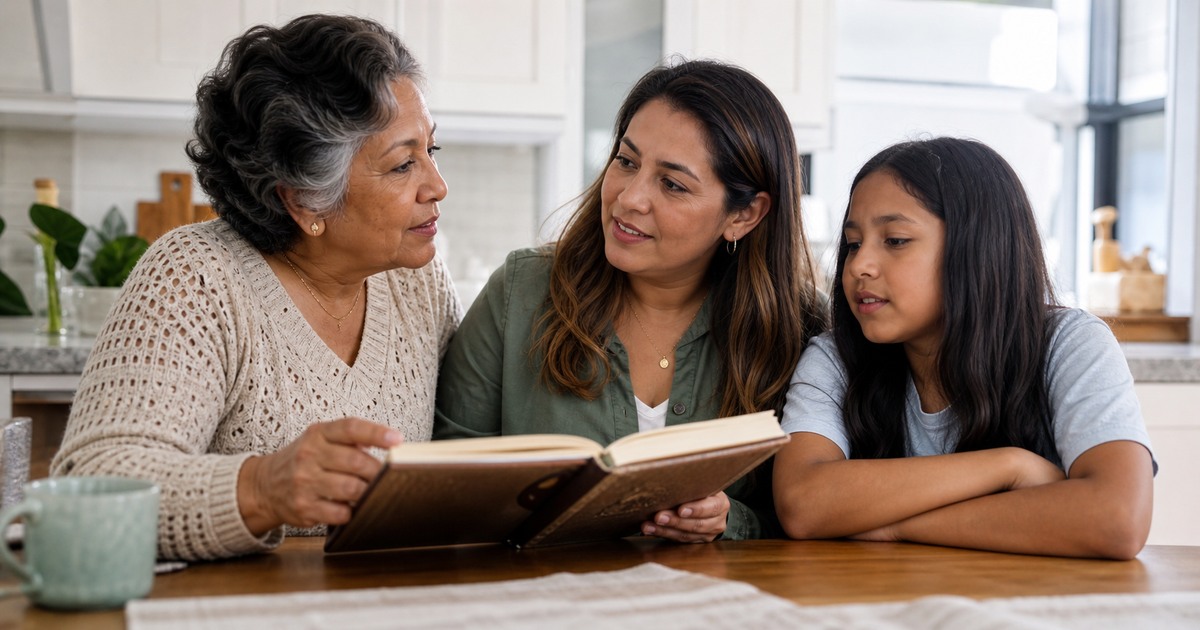
Families can share powerful intuitive traditions. That pattern may reflect culture, modeling, temperament, storytelling, and what a family learns to notice; science has not established a gene for psychic ability.
Quick Guide
- Use “runs in the family” as a description, not a genetic conclusion.
- Separate observation skills and shared stories from claims of supernatural inheritance.
- Support children without labeling them gifted, haunted, or responsible for adult decisions.
- Keep unusual experiences open to spiritual meaning and ordinary explanations.
Culture
Families pass down beliefs, language, rituals, and interpretations.
Learning
Children watch how adults read emotions and patterns.
Temperament
Relatives may share sensitivity, imagination, or vigilance.
Memory
Repeated family stories strengthen a shared identity.
Why the Pattern Can Feel So Convincing
One relative dreams about callers before the phone rings. Another is unusually accurate about moods. A grandparent kept a dream journal, and a child now describes vivid impressions. When similar stories cluster in a family, “the gift is inherited” can feel like the simplest explanation.
It is one possible spiritual interpretation, but it is not an established genetic fact. No validated test identifies a psychic gene. Family resemblance can arise through several overlapping pathways: shared biology affecting temperament, shared environments, social learning, expectations, selective memory, and a family vocabulary that encourages certain experiences to be noticed and retold.
Four Ways Families Transmit an Intuitive Identity
| Pathway | Example | What it does not prove |
|---|---|---|
| Observation | A child learns to notice tone, posture, routines, and conflict. | That every accurate impression is telepathy. |
| Storytelling | Striking dreams and coincidences become family legends. | That unremembered misses never occurred. |
| Temperament | Relatives share sensitivity, imagination, or anxiety traits. | A supernatural inheritance mechanism. |
| Spiritual tradition | Prayer, divination, ancestor stories, or rituals are taught. | That all relatives must believe or participate. |
Gifted Psychics’ article on how the brain predicts the future every day explains how ordinary forecasting uses memory and pattern recognition. When evaluating paid guidance, pair that with its comparison of psychic-site accuracy and consumer safeguards.
How to Talk With Children Safely
A child who reports a presence, dream, voice, or strong feeling needs calm curiosity—not a dramatic label. Ask what happened, when, whether they were awake or asleep, and how it felt. Check sleep, fever, medication, stress, bullying, sensory conditions, and exposure to frightening media. Reassure the child that they are safe and not responsible for predicting or preventing adult events.
Do not announce that a child is a medium, post their experiences publicly, or take them to repeated paid sessions without careful thought. Labels can shape memory and identity. If experiences cause fear, lost sleep, declining school function, confusion, or safety concerns, consult a qualified pediatric or mental-health professional.
A Better Family Experiment
- Each participant records impressions privately before discussing them.
- Use clear questions and a fixed time window.
- Write both hits and misses in the same place.
- Define what would count as accurate before the result.
- Check whether ordinary cues were available.
- Review kindly; the goal is learning, not proving a chosen identity.
This method protects relationships. Nobody wins status by being “most gifted,” and nobody is shamed for skepticism. Repeated, prospective records are more informative than dramatic memories reconstructed years later.
Respecting Cultural Traditions
Some families understand dreams, ancestors, prayer, or divination within a specific religious or cultural framework. Describe the practice by its own name and context rather than flattening every role into the modern English word “psychic.” Ask elders what the practice means, who may perform it, and what responsibilities come with it. Do not publish private ceremonies or claim traditions you were not taught.
Keeping the Gift Without Turning It Into Destiny
A family can value empathy, careful observation, dreams, ritual, and storytelling without insisting on certainty. Try language such as “Our family pays close attention to dreams” or “You noticed something important” instead of “You inherited a power.” This leaves room for growth, doubt, and different beliefs.
Intuition becomes more trustworthy when paired with feedback. Ask what cues may have informed the feeling, what evidence would change your mind, and which action is reversible. Whether the family interprets the experience as spiritual or psychological, humility is a strength.
Key Takeaways
- Family patterns do not by themselves establish genetic inheritance of psychic ability.
- Culture, social learning, temperament, attention, and memory can create real family resemblance.
- Children should be heard without being burdened with frightening or public psychic labels.
- Prospective records that include misses are more reliable than selective family legends.
Frequently Asked Questions
1. Are psychic abilities genetic?
Science has not established a psychic gene or a validated genetic test for supernatural ability.
2. Why do several relatives report similar experiences?
They may share temperament, environment, beliefs, attention habits, stories, and ways of interpreting coincidence.
3. Can intuition be learned?
Observation, emotional awareness, domain expertise, and reflective decision-making can all improve with practice.
4. Does a vivid dream prove a family gift?
No. Vivid dreams are common and need prospective recording before accuracy can be judged.
5. Should I call my child psychic?
Avoid fixed labels; listen calmly, protect privacy, and focus on the child’s comfort and functioning.
6. What if a child sees a figure at night?
Check sleep transitions, fear, illness, vision, media exposure, and safety; seek professional advice if it persists or distresses them.
7. Can anxiety feel like intuition?
Yes. Anxiety can create urgency and threat scanning, although a feeling may still contain useful cues.
8. How do we test family predictions fairly?
Record them before outcomes, define success, count misses, and prevent participants from influencing one another.
9. What is confirmation bias?
It is the tendency to notice and remember information that supports an existing belief more than information that challenges it.
10. Can family rituals still be meaningful?
Yes. Meaning does not require a claim of genetic or scientific proof.
11. Is sensitivity the same as psychic ability?
No. Sensory or emotional sensitivity may influence experience but does not establish paranormal perception.
12. Should health symptoms be interpreted spiritually?
Not as a substitute for assessment; new or disruptive symptoms deserve appropriate medical or mental-health evaluation.
13. How can skeptics and believers get along?
Use respectful first-person language, avoid coercion, and agree on safety and evidence standards.
14. Can a relative pressure me to develop a gift?
You have the right to decline readings, rituals, public sharing, or any spiritual role.
15. What is the healthiest family message?
Curiosity is welcome, uncertainty is allowed, and no child or adult is responsible for predicting the future.