

Updated
A personal mantra can be a short reminder of how you want to respond. It does not have to announce that everything is wonderful. For a difficult conversation, “I can take time before answering” may be more useful than trying to convince yourself that nothing bothers you.
This guide uses personal mantra to mean an everyday phrase you choose for yourself. It does not teach a sacred chant or claim that a repeated sentence has the same role as a mantra within a religious tradition.
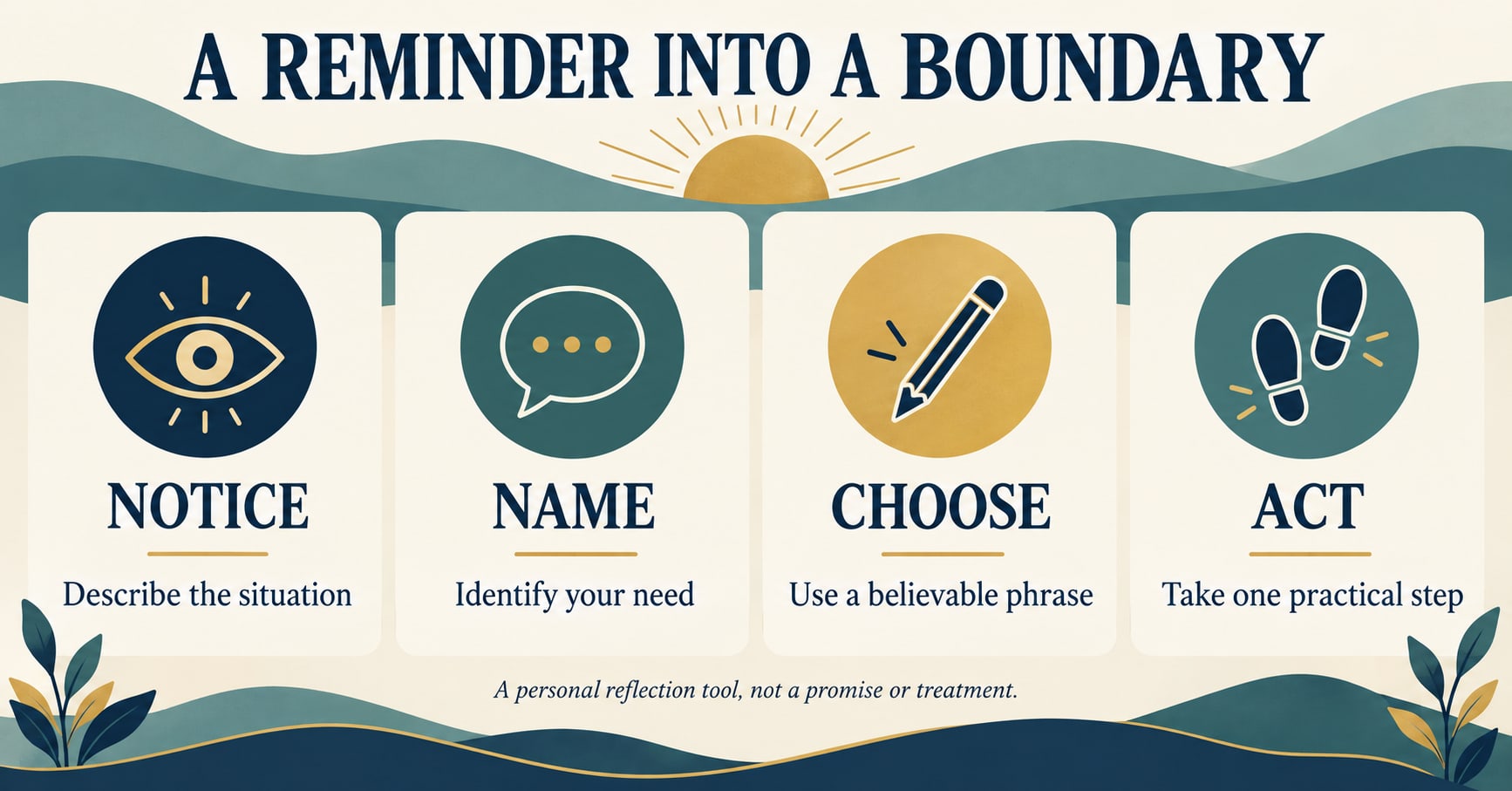
Notice, name, choose, act
- Notice the situation. Describe what happened without deciding what it says about your worth. For example: a friend asked for a favor when your week was already full.
- Name the need. You might need time, rest, more information or a clearer agreement. Pick the need that actually fits.
- Choose a believable phrase. Try “I can check my availability before agreeing” rather than “I always have unlimited energy.”
- Act on the reminder. Ask when an answer is needed, check your plans and give an honest response.
The phrase is only a cue. The practical value comes from the choice it helps you remember, not from saying it a prescribed number of times.
Three boundary reminders to adapt
- When you feel rushed: “I can ask for the details first.” Follow it by checking the request, timing and cost.
- When you want to explain endlessly: “A clear answer can be brief.” State what you can or cannot offer without trying to make everyone agree.
- When you made a mistake: “I can repair what is mine to repair.” Identify a specific apology or correction without accepting responsibility for everything.
These are original examples, not rules for every relationship. Where setting a boundary could lead to retaliation or violence, seek appropriate safety support rather than treating a phrase as protection.
Keep the wording honest
You can acknowledge disappointment and still choose an action. A reminder should not require denying pain, ignoring a practical obstacle or assuming that another person’s response is under your control.
A 2009 study by Wood and colleagues found that repeating a strongly positive self-statement did not help everyone and worsened mood for some participants with low self-esteem. That limited result is a reason to avoid promising that any affirmation will work for all readers.
Review the action, not your spiritual worth
After using the phrase a few times, ask whether it helped you pause, communicate or make a decision. If it felt false or distracting, change it or stop. There is no meaningful pass/fail score based on eleven questions, a bank balance or whether you feel happy today.
For conversations with a partner, our guide to relationship readings, questions and limits keeps reflection tied to real communication. A mantra can remind you to listen or speak clearly; it cannot supply someone else’s consent or guarantee a relationship outcome.